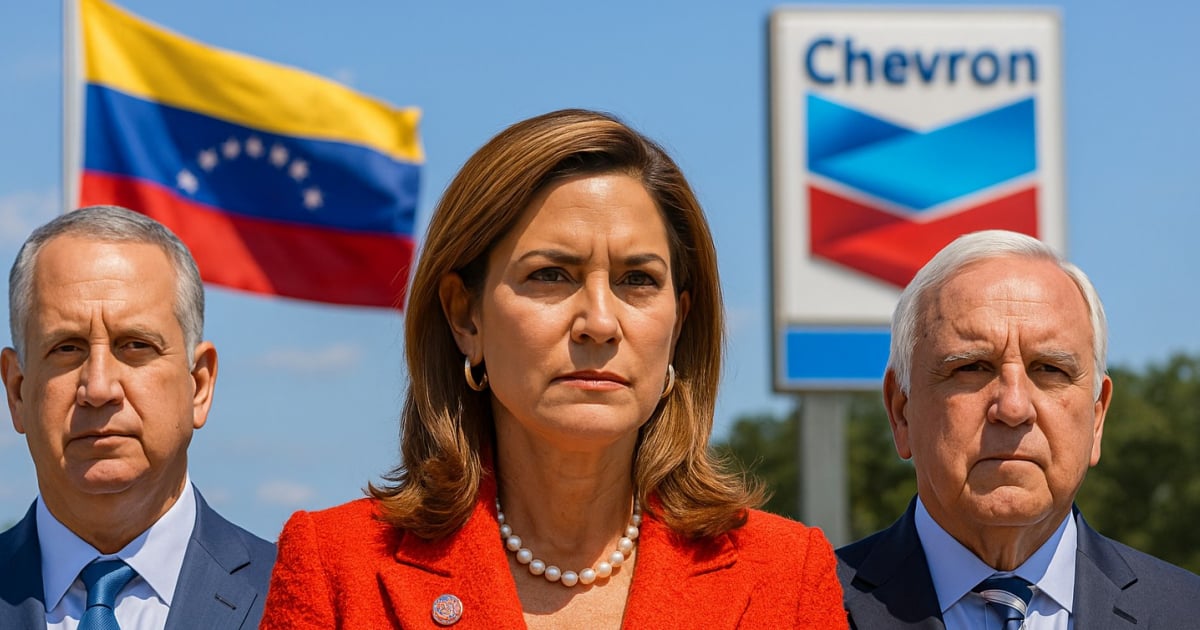
Last May, instead of leveraging their political influence to press Donald Trump on immigration issues—such as halting ICE raids or supporting I-220A and Humanitarian Parole beneficiaries—the three Cuban-American congressmen from Miami opted for an alternative approach. They subtly hinted at withdrawing their support for the Big Beautiful Bill (BBB) in the House of Representatives if Trump chose to revive Chevron's operations in Venezuela.
Earlier in February, the White House had revoked the oil corporation's license to operate in the South American country. However, by May, this decision was on the verge of being overturned due to secret negotiations between Nicolás Maduro and Trump's special envoy Richard Grenell.
As revealed by Axios, representatives Mario Díaz-Balart, María Elvira Salazar, and Carlos Giménez visited the White House to personally express their discontent to Trump. A week later, Díaz-Balart reached out to Trump via a phone call facilitated by Speaker of the House Mike Johnson, reiterating their anti-Maduro stance.
Although they did not explicitly threaten to withdraw their votes or engage in a quid pro quo concerning the Budget Bill negotiations, they made it clear that a deal with Caracas would be akin to extending the lifeline that Joe Biden had offered when he eased sanctions on Venezuela in 2022. "They will go crazy, and I need their votes," Trump reportedly told two confidants, according to Axios, as he leaned towards letting the Chevron negotiations die.
Secretary of State Marco Rubio also urged Trump to scrap the deal negotiated by his rival, Grenell, arguing that aiding Maduro would be a political and moral blunder. Ultimately, Trump decided—albeit temporarily—to cancel the multinational's license, allowing the "Three Crazy Cubans" (as dubbed by Johnson) to have their way and vote Yea for the BBB.
Díaz-Balart, Salazar, and Giménez quickly took to the media to sing Trump's praises for cutting off Venezuelan dictatorship income through Chevron's exports.
Chevron's Controversial Comeback
On July 24, The Wall Street Journal (WSJ) disclosed that Trump, in a characteristic reversal, had approved a new license for the oil giant to resume crude extraction in Venezuela. Many provisions of this "specific license" remain undisclosed, but according to WSJ, under the new agreement, neither profits nor taxes would end up in Maduro's hands.
Despite this, former officials of the Venezuelan state-owned PDVSA quickly argued on social media that a crude payment to Caracas would effectively provide a significant income source for its government. To date, the White House has not confirmed the agreement nor disclosed the fine print of the contract, but Maduro triumphantly announced the resumption of Chevron's operations on national TV.
The new deal was revealed just days after a swap involving 252 Venezuelans deported to El Salvador's CECOT prison in exchange for a dozen Americans, including a dual-national ex-marine incarcerated for multiple murders in Spain. WSJ reported that both Trump and Secretary of State Rubio were involved in the discussions for this exchange.
When asked if the prisoner swap was part of negotiations for Chevron's license reactivation, Maduro coyly replied, "In my years in the Foreign Service, I learned that sometimes you have to say: 'No comments.'
Political Fallout in Miami
As news about Chevron spread rapidly, past statements from the three Cuban-American congressmen emerged, harshly criticizing the Biden Administration for initially extending Chevron's license as part of a deal involving the release of political detainees and a national election agreement. “Either the Biden Administration is idiotic, or it’s betraying the cause of democracy in Venezuela,” Díaz-Balart had angrily summarized.
However, following Trump's reactivation of the deal, there was a complete reversal in Miami. The "Three Crazy Cubans" now endorsed Chevron's dealings with Maduro. A tweet, shared in both English and Spanish by the three Republican legislators, attempted to clarify their stance: “There is no greater defender of the Venezuelan people’s freedom than President Trump. His record is clear in standing up to anti-American dictators in the Western Hemisphere who constantly seek to undermine U.S. national security.”
Not a single criticism or reservation was voiced against decisions they had previously condemned unequivocally as idiotic or traitorous. Ultimately, their political gamble failed. In their bid to avoid displeasing Trump, they refrained from using their influence to support hundreds of thousands of immigrants—like themselves or their parents once were—facing deportation back to the very dictatorships they fled.
They believed they could appease their core local electorate by demonstrating firmness against Venezuela—a less sensitive issue for Trump and MAGA than immigration—and bet everything on the Chevron card. The outcome: Trump ignored them on both fronts, offering nothing but a costly lesson—no progress on immigration, no Chevron victory. Moreover, he continues to deprive them of electoral oxygen, with decisions perceived as overtly hostile by vast segments of the Hispanic community.
The Secretary of State has been playing all sides. Shortly before the Chevron affair, Rubio had issued a memorandum announcing a drastic shift in foreign policy: henceforth, the State Department would refrain from public comments on foreign elections (including Venezuela's?) and instead focus more on “the strategic interests of the United States” over the values—or anti-values—of other nations.
Regarding Chevron, Rubio transitioned from opposing the transaction to publicly endorsing it, akin to a postmodern Fouché, without a hint of shame. He's betting heavily on becoming the designated hitter for 2028, aiming to position himself above James David Vance. And to achieve this, he knows he only needs to respond with two words: “Yes, Sir.”
Insights into U.S. Policy and Chevron's Role in Venezuela
Why did Trump initially cancel Chevron's license in Venezuela?
Trump initially canceled Chevron's license as part of a broader strategy to apply pressure on the Maduro regime and curtail their economic resources derived from oil exports.
What was the reaction of the Cuban-American congressmen to Trump's policy changes?
The Cuban-American congressmen initially supported Trump's decision to cancel Chevron's license, but later found themselves in a difficult position when he reversed the decision, forcing them to adjust their stance publicly.
How has Rubio's foreign policy approach changed recently?
Rubio announced a shift in foreign policy, indicating that the State Department will prioritize U.S. strategic interests over public commentary on foreign elections, suggesting a more pragmatic approach in international relations.