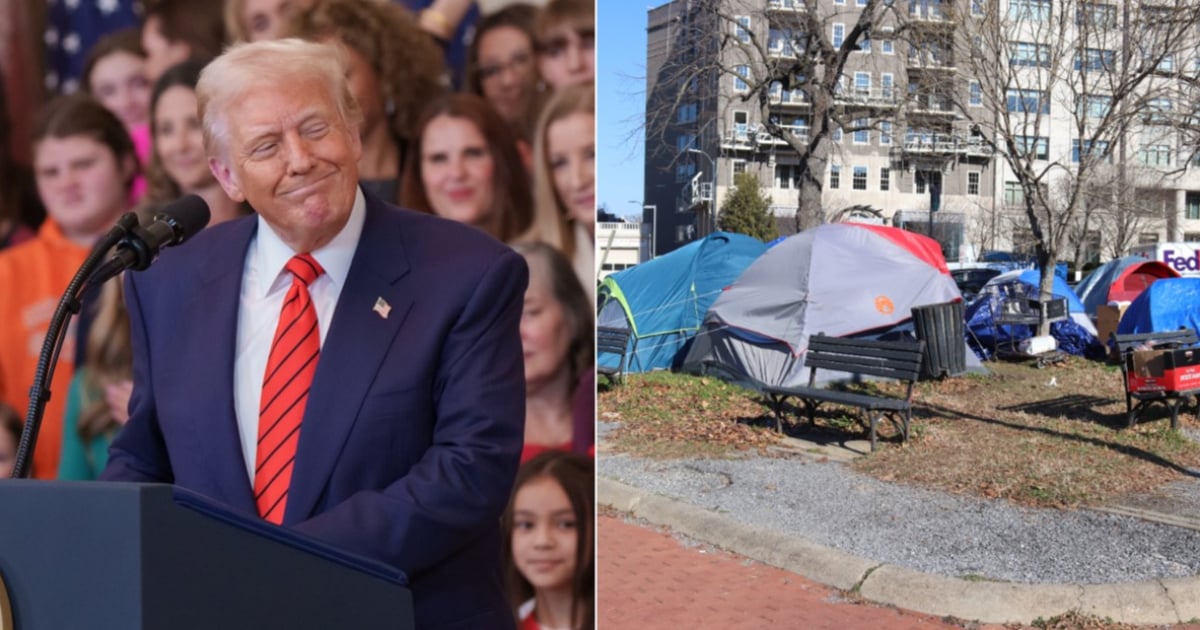
On Friday, President Donald Trump enacted an executive order empowering cities and states to remove homeless individuals from the nation's streets and place them in treatment facilities. This initiative is part of his "Make America Safe Again" campaign. The order, known as Ending Vagrancy and Restoring Safety, directs Attorney General Pam Bondi to overturn court rulings and legal agreements that have previously restricted local authorities in addressing urban encampments and homelessness, according to FOX News.
Additionally, the order mandates the reallocation of federal funds to support rehabilitation, treatment, and reintegration programs for those affected. "Trump is fulfilling his commitment to make America safe again," stated White House spokesperson Karoline Leavitt. However, numerous critics have raised concerns about the potential criminalization of poverty. Trump himself expressed dismay after witnessing individuals sleeping outside the White House gates, stating, "I think it's terrible, and we will remove them immediately."
The order instructs Bondi to collaborate with Health and Human Services Secretary Robert F. Kennedy Jr., Housing Secretary Scott Turner, and Transportation Secretary Sean Duffy to prioritize federal grants for states and municipalities that enforce laws against drug use in public spaces, urban camping, and illegal property occupation. Furthermore, it prohibits the use of federal funds designated for addiction prevention and treatment from supporting drug injection centers or supervised consumption practices.
According to the executive order, during the final year of President Joe Biden's administration, over 274,000 individuals were reported living on the streets across the United States on a single night—the highest number recorded to date. A report by the Department of Housing and Urban Development released in January highlighted an 18% increase in homelessness between 2023 and 2024, an unprecedented rise attributed to the economic crisis, rising living costs, and lack of structural solutions.
Trump had previously hinted at this measure in March, vowing to "clean up" American cities, including Washington D.C., where he promised an end to violent crime. "We will have a crime-free capital. It will be cleaner, better, and safer than ever," he declared at that time.
While the full content of the order is still under review by lawmakers and civil rights advocates, it has already sparked mixed reactions. Some view it as a step towards "restoring public order," while human rights organizations caution against the potential dangers of criminalizing poverty and homelessness.
FAQs on Trump's Executive Order on Homelessness
What is the purpose of Trump's executive order on homelessness?
The executive order aims to relocate homeless individuals from the streets to treatment facilities, as part of Trump's "Make America Safe Again" campaign.
How does the executive order intend to address homelessness?
It empowers cities and states to remove homeless people from streets, reallocates federal funds for rehabilitation, and prohibits federal funding for drug injection sites.
What are the criticisms surrounding this executive order?
Critics argue that it may result in the criminalization of poverty and homelessness, while human rights organizations highlight potential risks.