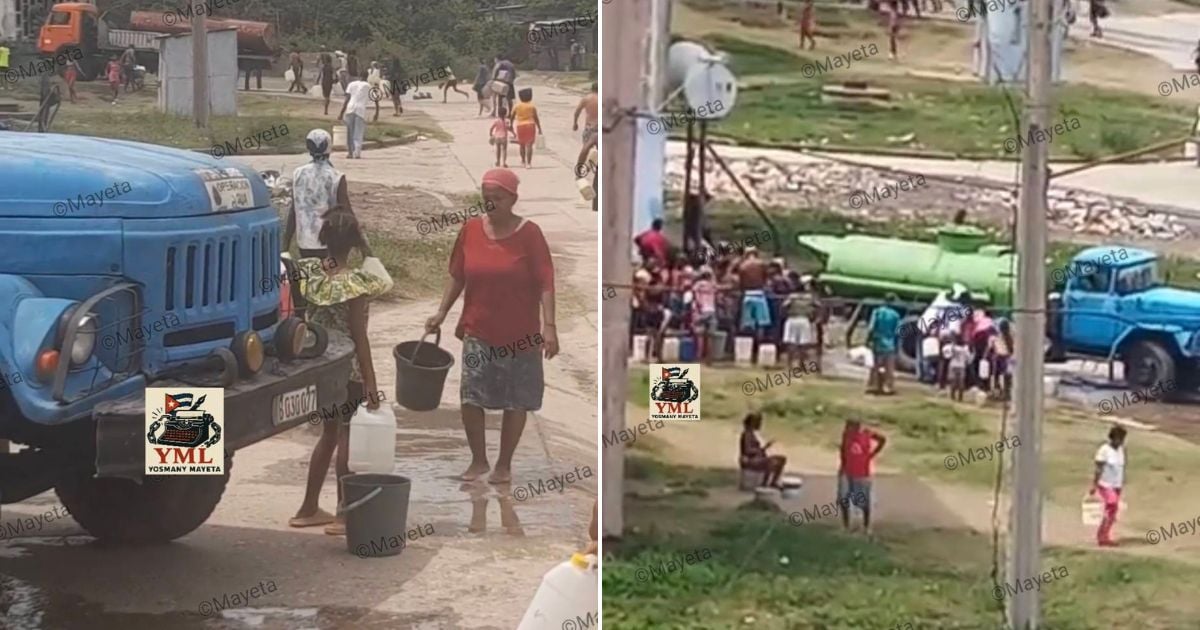
The dire need for drinking water has transformed the streets of Santiago de Cuba into scenes of daily chaos. Mothers clutching infants, elderly citizens, and men carrying containers race after water trucks as if they were ambulances in the midst of an emergency. In a city where turning on the tap has become a privilege, accessing water is no longer a basic right but a survival challenge.
Independent journalist Yosmany Mayeta Labrada highlighted this distressing reality on Facebook, describing it as part of the "agonizing reality" endured by thousands of Santiago residents each day. "Chase a truck or die of thirst," Mayeta succinctly captured the severity of a crisis that the regime attempts to hide while the populace suffers.
The Unseen Struggles of Santiago's Residents
Neighborhoods like Sueño, Altamira, Micro 9, Agüero, San Pedrito, and Mariana de la Torre have reported over 20 consecutive days without a drop of water. The so-called solution—water trucks—arrives unannounced, insufficient, and fails to ensure fair access. They don't serve high-rise buildings, neglect the vulnerable, and often distribute based on political favoritism.
High-rise apartments have become prisons of despair, where the elderly, pregnant women, or those with limited mobility must haul buckets up dark, treacherous staircases, risking accidents due to inadequate infrastructure. Water tanks are empty, pumps are broken, and authorities are absent, summarized Mayeta, a vocal critic of the regime who frequently echoes Santiago's misfortunes.
Health Hazards and Government Neglect
The health risks are mounting as people resort to storing water in inappropriate containers like used paint buckets, rusty tanks, and open plastic bottles, leading to outbreaks of intestinal diseases, dengue, leptospirosis, and other maladies already reported in local medical centers.
"This isn't a drought or a coincidence; this is a crime of negligence," Mayeta accused, pointing out the stark contrast between public suffering and the privileges of officials: "Santiago dries up, but the leaders bathe. The people fall ill, but they toast."
Amidst the chaos, a woman's cry summed up the sentiment of many in this eastern city: "Spread the word, Mayeta, if the water doesn't flow, at least let the truth flow." A truth that the regime suppresses, yet it spreads, just like the people chasing after water trucks. Because today in Santiago de Cuba, life is a race for water, dignity, and truth.
Water Crisis Worsens Amidst Drought
The province of Santiago de Cuba is grappling with one of its worst droughts in recent years, severely impacting water supply, particularly in the main municipality, where vast areas have gone over two months without the vital resource. The situation was detailed by the official newspaper Sierra Maestra, which published statements from Ludmila Rodríguez Barroso, director general of Aguas Santiago. She acknowledged, "There is no water and no forecast" for when the service might stabilize.
Rodríguez Barroso explained that the Quintero system—responsible for supplying over 80% of the city—has significantly reduced its capacity due to decreased flow from main sources like Gota Blanca and Gilbert. Since July 7, the Gota Blanca station has ceased operations entirely, and the Gilbert station has reduced output, leaving only one of the five Quintero system pipelines operational. This has limited water intake to merely 900 or 1,000 liters per second, far below what's needed for a stable distribution cycle.
Areas such as Altamira, Van Van, Versalles, El Caney, Boniato, and El Cristo are among the hardest hit. Some regions have been deprived of piped service for more than 60 days, relying solely on tanker trucks. Rodríguez Barroso noted that even with these measures, regular access for the entire population cannot be guaranteed: "We are beyond 20 days, and the most critical zones exceed 60 days."
However, the water scarcity issue extends beyond local boundaries, affecting a million people nationwide. Antonio Rodríguez Rodríguez, president of the National Institute of Hydraulic Resources (INRH), admitted that this problem stems from the energy crisis, lack of material resources, and persistent drought.
Understanding Santiago's Water Crisis
What is causing the water crisis in Santiago de Cuba?
The water crisis in Santiago de Cuba is primarily due to a severe drought, reduced capacity of major water sources, and inadequate infrastructure. Additionally, the energy crisis and lack of necessary resources exacerbate the situation.
How are residents coping with the water shortage?
Residents are chasing water trucks for supply, often storing water in unsuitable containers. High-rise residents face additional challenges, having to carry water up stairs due to the lack of elevator service.
What health risks are associated with the water crisis?
Storing water in inappropriate containers can lead to health issues such as intestinal diseases, and outbreaks of dengue and leptospirosis have been reported.