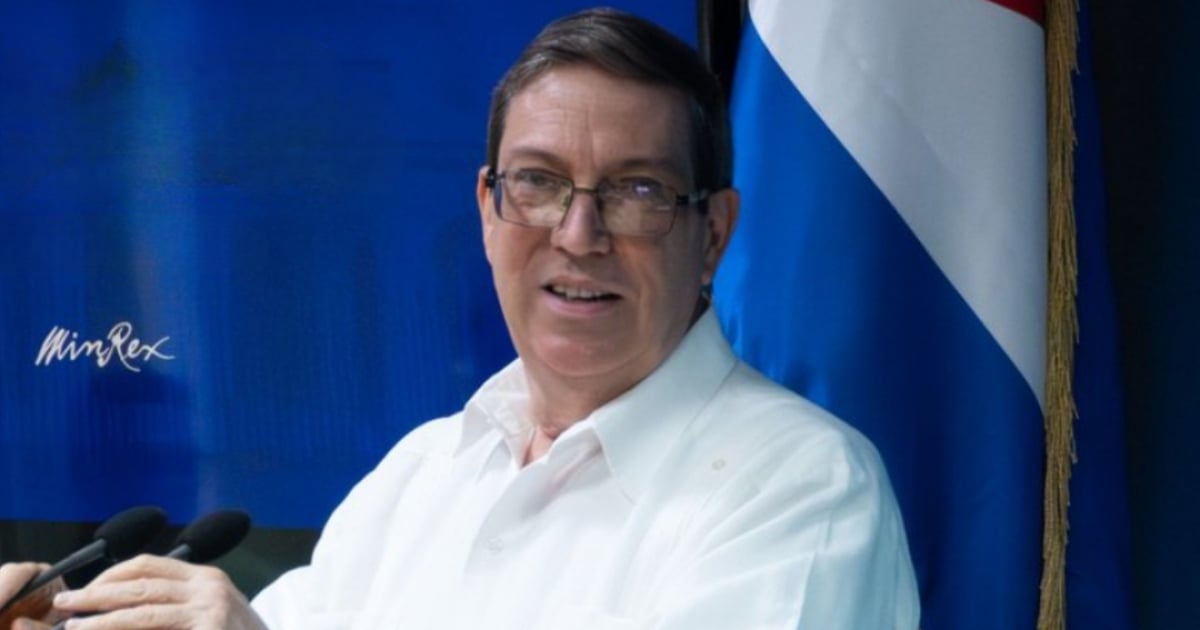
The Cuban government has consistently refused to take back its citizens with criminal records deported from the United States, yet it did not hesitate to commend Nicolás Maduro for welcoming over 250 Venezuelan migrants accused of being part of a dangerous criminal gang. On the social media platform X, Cuban Foreign Minister Bruno Rodríguez Parrilla celebrated the "liberation" of Venezuelans deported by the U.S. and imprisoned in El Salvador, who were handed over to Maduro's regime in exchange for political prisoners and American citizens.
"The return of these citizens to Venezuela marks a triumph for the Bolivarian and Chavista Revolution led by President Nicolás Maduro," Rodríguez stated. The operation, which was confirmed by Salvadoran President Nayib Bukele, involved the transfer of 252 Venezuelan migrants detained at the Center for the Confinement of Terrorism (Cecot).
Most of these individuals allegedly have ties to the criminal group Tren de Aragua. In return, Caracas released an unspecified number of political prisoners and ten Americans held in Venezuela. "As offered to the Venezuelan regime in April, we conducted this exchange for a significant number of Venezuelan political prisoners, individuals whom that regime had kept in its prisons for years," Bukele stated.
Contrasting Policies in Cuba and Venezuela
Meanwhile, Havana maintains a contrasting policy. Immigration lawyers have criticized the Cuban government for only accepting the return of young citizens without criminal backgrounds, leaving many Cuban criminals out of the repatriation process. Due to Miguel Díaz-Canel's government's refusal to accept criminals, the United States has been compelled to deport some Cubans to third countries, as recently happened with two individuals sent to South Sudan, one of the world's most unstable nations.
The Department of Homeland Security reported that both men have extensive criminal records. Enrique Arias-Hierro was convicted of homicide, armed robbery, kidnapping, identity theft, and burglary. José Manuel Rodríguez-Quiñones faced charges for attempted murder, physical assault, theft, and canine trafficking. Both were deemed public safety threats.
The Complexities of Cuban Migration Policy
"Generally speaking, when we wish to deport a Cuban citizen, we notify the regime. If they do not accept, we must seek other solutions," explained Mike Hammer, the U.S. Embassy's Charge d'Affaires in Cuba, during a press conference in Miami.
Cuba's migration policy seems to have a different standard depending on who the ally is. While it applauds Maduro's decision to receive individuals accused of being part of a criminal organization, it refuses to accept its own nationals if they pose an issue for its image or internal governance. Once again, Havana showcases its double standards: it demands respect for migrants while being selective about whom it allows to return home.
Frequently Asked Questions About Cuban and Venezuelan Migration Policies
Why does Cuba refuse to accept citizens with criminal records?
The Cuban government is selective about the citizens it allows to return, particularly avoiding individuals with criminal backgrounds that could tarnish its image or disrupt its internal governance.
How did Venezuela benefit from the recent migrant exchange?
Venezuela received over 250 migrants who were accused of criminal activities, while it released an unspecified number of political prisoners and ten Americans, which was seen as a diplomatic success for the Maduro administration.
What challenges does the U.S. face in deporting Cuban criminals?
The U.S. faces difficulties when Cuba refuses to accept deported criminals, often leading to the need to find third countries willing to take them, as seen with the recent deportations to South Sudan.