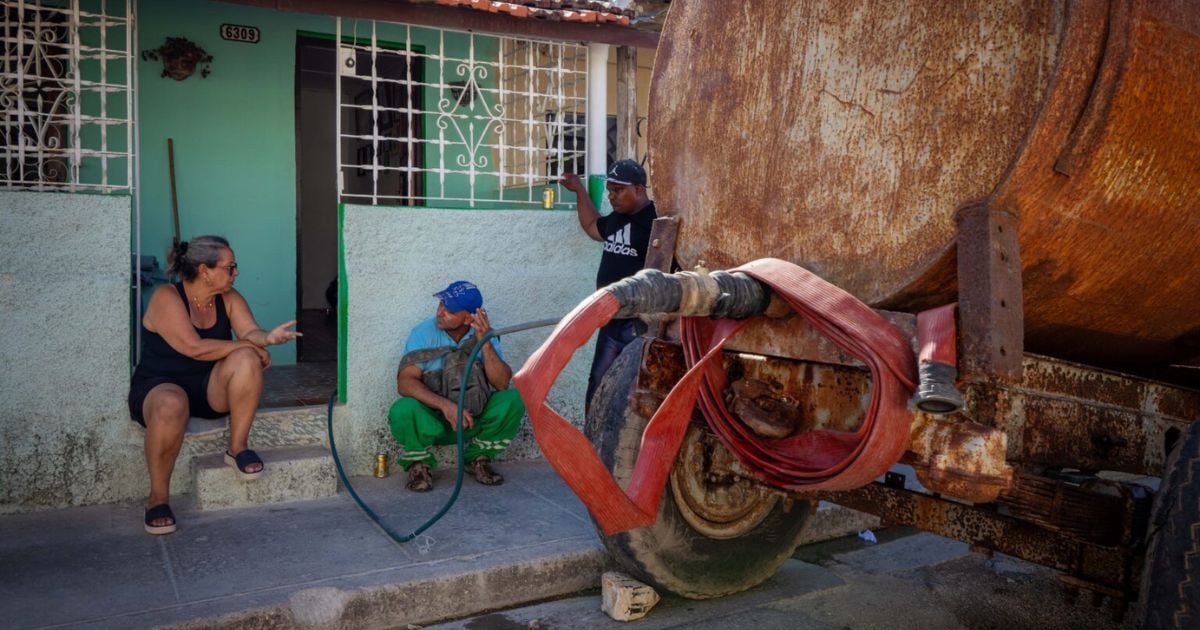
The province of Santiago de Cuba is experiencing one of its most severe droughts in recent history, severely impacting water supplies. The provincial capital is particularly hard-hit, with many areas going over two months without receiving essential water services.
This dire situation was highlighted by the state-run newspaper Sierra Maestra, which featured statements from Ludmila Rodríguez Barroso, the general director of Aguas Santiago. She admitted that "there is no water and no forecast" for when the service might stabilize. According to Rodríguez Barroso, the Quintero system, which supplies over 80% of the city, has seen a dramatic reduction in capacity due to decreased water flow from primary sources like Gota Blanca and Gilbert.
Since July 7th, the Gota Blanca station has completely ceased operations, while Gilbert has significantly reduced its output, leaving only one out of five Quintero system pipelines functional. This has limited water intake to a mere 900 or 1,000 liters per second, far below what is needed to maintain a stable distribution cycle.
Neighborhoods such as Altamira, Van Van, Versalles, El Caney, Boniato, and El Cristo are among the hardest hit. Some areas have gone more than 60 days without piped service, relying solely on water trucks. Rodríguez Barroso noted that even with these supplementary measures, regular access to water for the entire population cannot be assured: "We are over 20 days, and the most critical zones exceed 60 days."
Authorities have taken steps such as eliminating non-essential connections, reducing irrigation, and limiting water use in animal husbandry. Efforts are underway to repair pumping stations and bring in additional equipment from other provinces, but the results remain inadequate. As reservoirs remain depleted and the country's ongoing energy crisis hampers the use of power generators, the forecast remains uncertain. Rodríguez Barroso emphasized, "With this situation, no forecast can be given."
The water crisis in Cuba continues to worsen, with alarming conditions in several provinces. In Guantánamo, the main reservoir is nearly dry, leaving residents without reliable water access and creating an emergency situation during the summer. Nationwide, the statistics are stark: over half a million Cubans are affected by the drought, with provinces like Santiago de Cuba, Las Tunas, and Holguín facing prolonged water supply cuts.
Access to water has become a luxury and has sparked criticism, even in official media. In Matanzas, a state-run newspaper made waves by openly reporting the severity of the problem, pointing to local authorities' inaction amid public desperation. Such reports, rare in state discourse, reveal the deep social unrest stemming from years of neglect.
In the capital, water shortages have been exacerbated by electrical instability, directly affecting pumping and distribution in the most populous neighborhoods. The combination of drought and outdated infrastructure has plunged Havana into a sanitary crisis that threatens to escalate further if urgent measures are not implemented.
Understanding the Water Crisis in Cuba
What is causing the water shortage in Santiago de Cuba?
The water shortage is primarily due to a severe drought which has reduced water flow from key sources that supply the city, exacerbated by outdated infrastructure and insufficient water management.
How are residents coping with the lack of water?
Many residents are relying on water trucks for their supply, as piped water service has been unavailable for extended periods in several areas.
What measures are being taken to address the crisis?
Authorities are attempting to repair pumping stations and bring in additional equipment, while also implementing water use restrictions and eliminating non-essential connections.