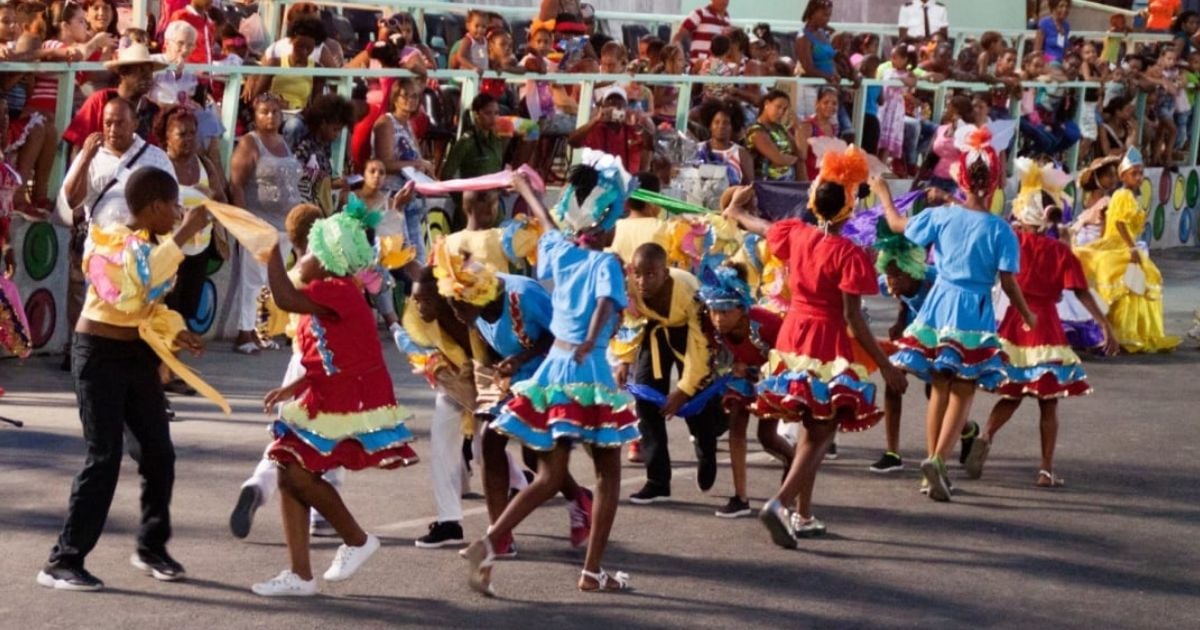
Despite widespread criticism and the country's severe energy crisis, the Cuban regime has decided to make an "effort" to proceed with the Santiago de Cuba carnival from July 23 to 27. This event, which goes beyond mere festivities, holds a deep cultural significance in the local identity. The government appears to understand that canceling the renowned Rumbón Mayor could spark further social unrest in a historically volatile city. To navigate this, they’ve chosen a political maneuver: continue the celebrations but impose a strict cutoff at 10:00 p.m., essentially "tugging at the chain without disturbing the monkey."
According to reports by the Cuban News Agency, as cited by TV Santiago, local authorities have confirmed that the carnival will proceed with substantial schedule adjustments due to the emergent energy crisis caused by the unexpected shutdown of the Antonio Guiteras Thermoelectric Plant, a major electricity supplier on the island. "The generation deficit has worsened," acknowledged Javier Calero Román, the general director of Santiago de Cuba's Electric Company. "Thus, we have decided to reorganize the carnival schedule to protect the population and ensure responsible enjoyment of the festivities."
Among the measures implemented, Yaneidis Hechavarría, president of the Municipal Assembly of People's Power, outlined that parades featuring comparsas, congas, and floats will take place from 6:00 p.m. to 10:00 p.m. Festival areas will operate from 2:00 p.m. until 10:00 p.m., at which point music will cease, and services will be withdrawn. This stringent restriction is likely to be accompanied by a significant deployment of security forces to ensure everyone leaves peacefully once the speakers are silenced.
An alternative programming plan will be developed within communities, allowing local groups to perform near their neighborhoods, easing access for residents without overburdening central areas, Hechavarría emphasized. Authorities stress that these decisions are in response to public demands, particularly following the prolonged blackouts in recent weeks that have led to an uneven distribution of electricity in the province.
Meanwhile, José Arce, provincial director of the Industrial and Food Production Company (EPIA), assured that basic resources will be available to guarantee food offerings, noting that “the bakery will be the main source of information and supply during these days.” What the official did not mention is that a significant portion of the supply will fall into the hands of the private sector, with prices far from affordable for most of the population, contradicting the popular essence of the festival.
Although the carnival will still occur, it will be a scaled-down event with heightened surveillance and numerous restrictions in a city where music, street life, and dissatisfaction coexist year-round.
Understanding the Santiago de Cuba Carnival Amid Energy Crisis
What are the new hours for the Santiago de Cuba Carnival?
The carnival will have adjusted hours, with festivities and parades running from 6:00 p.m. to 10:00 p.m. and festival areas operating from 2:00 p.m. to 10:00 p.m.
Why is the carnival schedule being changed?
The schedule adjustment is in response to the emergent energy crisis caused by the unexpected shutdown of a major thermoelectric plant, aiming to protect the population while allowing responsible enjoyment.
How will local authorities ensure safety during the carnival?
A significant deployment of security forces is expected to ensure that everyone leaves peacefully once the festivities end at the designated time.