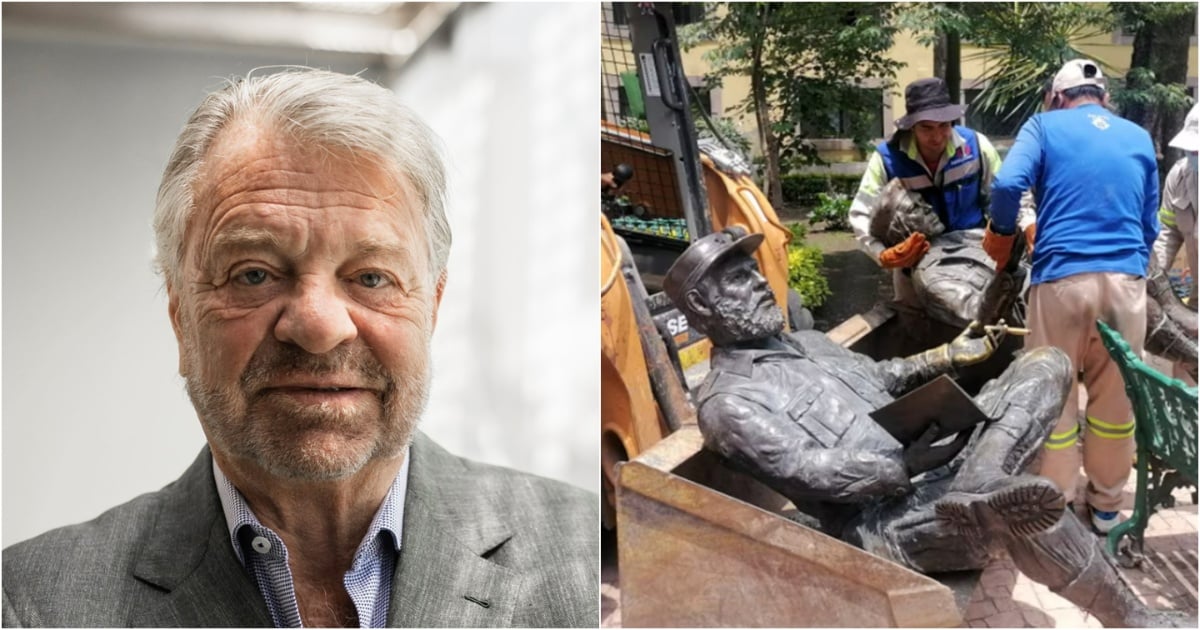
Jorge G. Castañeda, a former Mexican foreign minister, has openly criticized the government of Claudia Sheinbaum for its admiration of the Cuban dictatorship in light of the recent removal of statues of Fidel Castro and Che Guevara from the Tabacalera Park in the Cuauhtémoc district of Mexico City. In an opinion piece for Nexos, Castañeda emphasized that the events surrounding the statues' removal could spark a discussion about the increasingly authoritarian nature of the Fourth Transformation and its deep-seated admiration for Castro's regime.
Castañeda cited the example of Chile, where communist Jeanette Jara, a supporter of Havana's regime, has been selected as the leftist candidate for upcoming elections. "How can one believe in Jara's democratic intentions if she cannot clearly distance herself from the island dictatorship? How can she defend Chilean democratic principles against far-right candidates without condemning the existence of nearly a thousand political prisoners in Cuba? How can she propose a sensible, moderate, and modern economic platform while still applauding the complete failure of the Cuban regime and blaming the United States for all of its woes?" Castañeda questioned.
The Broader Implications of Statue Removal
The former diplomat pondered the scenario where a conservative district had erected a statue of Mussolini or Pinochet, and upon Morena coming to power in those districts, there were pressures to remove it. "What differentiates the Chilean, Spanish, and Italian dictatorships from the Cuban one? One major difference is the longevity of the Cuban dictatorship, which has lasted 66 years, compared to Mussolini's two decades, Franco's 30 years, and Pinochet's mere 17," he argued.
Castañeda lamented that Cuba does not figure prominently in Mexican discussions as it does in Chilean debates. "It would greatly help us understand what everyone in Mexico truly thinks. Additionally, it seems reckless for the government to continue supporting Díaz-Canel's dictatorship, especially knowing that a directive from Trump condemning and possibly prohibiting such support could arrive at any moment," concluded Castañeda, who served as Mexico's Secretary of Foreign Affairs under Vicente Fox from 2000 to 2003.
Controversy Over Statue Removal
On July 17, the controversial statues of Fidel Castro and Ernesto Che Guevara, located in the Jardín Tabacalera of the Cuauhtémoc district, were finally removed by decision of Mayor Alessandra Rojo de la Vega, following irregularities in their installation and numerous complaints from local residents. Rojo de la Vega publicly defended the decision, sparking a significant debate across social media and in the press.
The action has stirred controversy, especially among vocal supporters of the Cuban Revolution in Mexico. However, Rojo de la Vega reaffirmed her stance, citing respect for human rights and the wishes of the community's residents. "Citlali, dictatorships and oppressive regimes are harmful regardless of their origin. A murderer is a murderer, whether they are right, center, or left," she wrote on her account on X (formerly Twitter), responding to criticisms from Senator Citlalli Hernández. "If you have a totalitarian agenda, just say it as it is."
In another post, Rojo de la Vega clarified that the removal of the statues was not due to personal whim but rather compliance with legal procedures requested by the public. "It's not bureaucracy; it's the law... these aren't my arguments; they are the correct administrative processes," she stated. "I believe in democracy and legal certainty," the mayor defended.
Mexican President Claudia Sheinbaum entered the fray, suggesting the statues could be relocated elsewhere, considering them part of a "historical moment" linked to the shared history between Cuba and Mexico.
Frequently Asked Questions about Statue Removal and Political Implications
Why were the statues of Fidel Castro and Che Guevara removed from Jardín Tabacalera?
The statues were removed due to detected irregularities in their installation and numerous complaints from local residents, as per the decision of Mayor Alessandra Rojo de la Vega.
What is the significance of the statue removal in a political context?
The removal has sparked a debate about the Mexican government's admiration for the Cuban dictatorship and raised questions about the authoritarian nature of the Fourth Transformation.
How has the Mexican public reacted to the removal of the statues?
The decision has generated significant debate and controversy, particularly among supporters of the Cuban Revolution in Mexico, though the mayor cited community wishes and legal procedures as reasons for the removal.