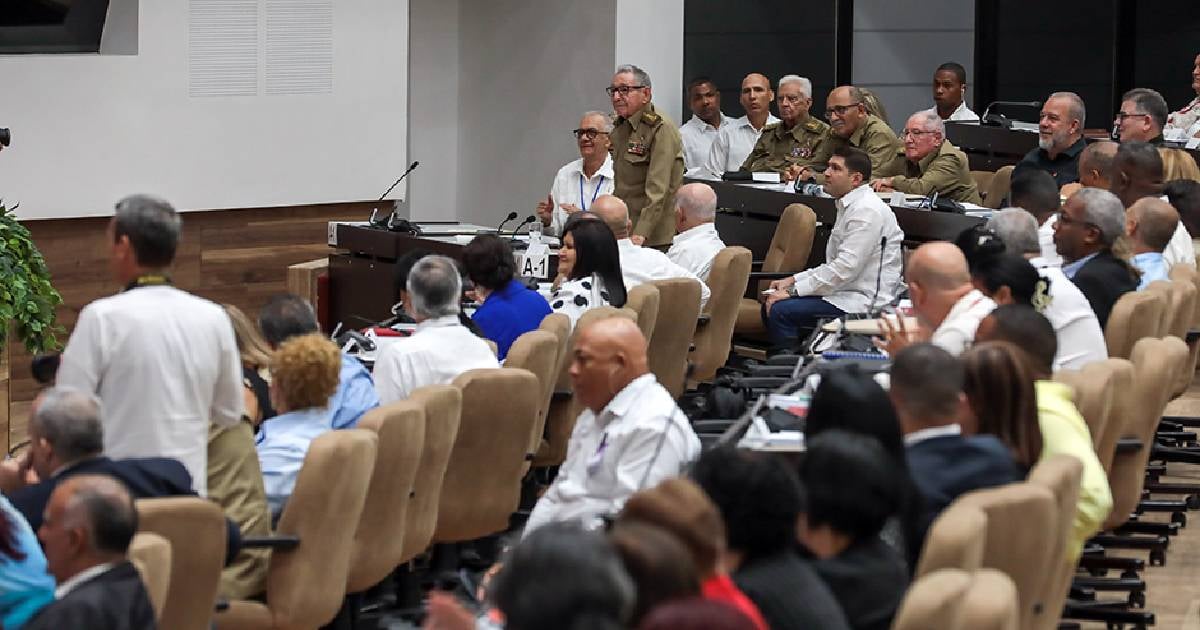
Raúl Castro, who initially championed the age cap of 60 for first-time presidential candidates in 2019, has now pushed for its removal. This constitutional reform was approved by the National Assembly of People's Power (ANPP) without any visible dissent or debate. Unlike a grassroots movement or parliamentary proposal, it was Castro himself, now 94, who requested the amendment from the Communist Party's Political Bureau, as revealed by ANPP President Esteban Lazo on the state-run website Cubadebate.
The proposal received backing from the Council of State before being presented to the legislative body, where all 440 deputies voted in favor without objection. The amendment eliminates the second paragraph of Article 127 of the Constitution, which previously set an age limit for first-time presidential candidates. Lazo explained that the purpose is to avoid excluding individuals "in full use of their faculties" due to age, especially given the country's aging population.
The Shift in Age-Related Policies
In April 2016, during the Seventh Congress of the Communist Party of Cuba (PCC), Castro announced age limits of 60 for joining the PCC Central Committee and 70 for holding leadership roles within the organization. These limits, along with a proposal from the earlier congress in April 2011 to restrict political responsibilities to two consecutive terms, were intended to ensure systematic rejuvenation across party positions, as Castro stated at the time.
The draft Constitution discussed in 2018 and ratified in 2019 also introduced age restrictions for the presidency, but only for the first term, requiring candidates to be between 35 and 60 years old. Now, the argument has shifted to prioritize the experience of older figures who have demonstrated "loyalty" to the Revolution. No public consultation was sought for this modification, as it does not affect the president's powers or term limits, according to Article 228 of the Constitution.
Demographic and Political Justifications
Deputies such as Edelso Pérez, Raúl Alejandro Palmero, and Yaisel Peter Terry defended the amendment, citing flexibility in the Constitution due to demographic and political reasons. "This does not relate to the president's term lengths or powers but rather a requirement that was necessary in 2019. Today's Cuba demands a strong commitment to the nation and the people," stated Peter Terry, a deputy from Ranchuelo, Villa Clara.
Palmero, a deputy from Arroyo Naranjo and the first secretary of the Union of Young Communists in Havana, argued that legal and political systems must evolve over time, suggesting that the reform increases the pool of eligible candidates. The dominant narrative emphasized adaptation and continuity, asserting that the reform aligns with "current circumstances" rather than contradicting constitutional principles.
Population Decline and Political Spectacle
Since 2019, Cuba has experienced a population decline, with more deaths than births recorded, as reported in 2024 by Prime Minister Manuel Marrero Cruz. By the end of 2024, 25.7% of the Cuban population was aged 60 or older, according to the latest data from the National Office of Statistics and Information (ONEI).
Moreover, over 250,000 Cubans left the island in 2024, as per official ONEI figures, a year marked by the lowest birth rate in six decades, increased mortality, and sustained population decline compared to 2023. The resident population in Cuba has alarmingly decreased in recent years, with independent economist and demographer Juan Carlos Albizu-Campos estimating it to have fallen below eight million, a 24% drop in just four years, comparable to wartime scenarios.
Yet, the move underscores who remains in control of state decisions. Castro not only set the 2019 age limit but now advocates for its removal, with no challenge to this pivot within the ANPP, regarded as the "supreme organ of state power" representing the people's sovereign will, according to Article 102 of the Constitution.
This Friday, the conclusion of the ANPP's fifth regular session was marked by a spectacle featuring Castro shouting in support of President Miguel Díaz-Canel. The scene was shared in an official post by the Cuban presidency, hailing the sessions as a "genuine Assembly of the people." Standing behind the former leader, Díaz-Canel responded with "Long live Raúl!" completing a political display intended to publicly reinforce unity in the Cuban regime's leadership amid a week of controversies.
The legislative sessions were also overshadowed by the scandal involving the now-former Labor Minister after her controversial statements claiming there are no beggars in Cuba, only "people disguised" as poor. A parliamentary commission applauded Marta Elena Feitó's remarks without criticism, but once her speech reached the media, it sparked a wave of backlash on social media, prompting Díaz-Canel to denounce the official, who was eventually dismissed from her post.
Castro took advantage of the Assembly's closure to publicly pledge his support for the current president, viewed by many as a demonstration of control amid the island's social, economic, and political turbulence.
Frequently Asked Questions about Cuba's Political Changes
Why did Raúl Castro propose removing the presidential age limit?
Raúl Castro proposed removing the age limit to allow the inclusion of individuals with significant experience who remain capable, especially given Cuba's aging population.
What was the response to the constitutional amendment in Cuba?
The constitutional amendment was approved unanimously by the National Assembly of People's Power, with no visible dissent or debate.
How does the removal of the age limit impact Cuba's political landscape?
The removal of the age limit potentially broadens the pool of eligible candidates for the presidency, allowing experienced figures to take on leadership roles, provided they have shown loyalty to the Revolution.