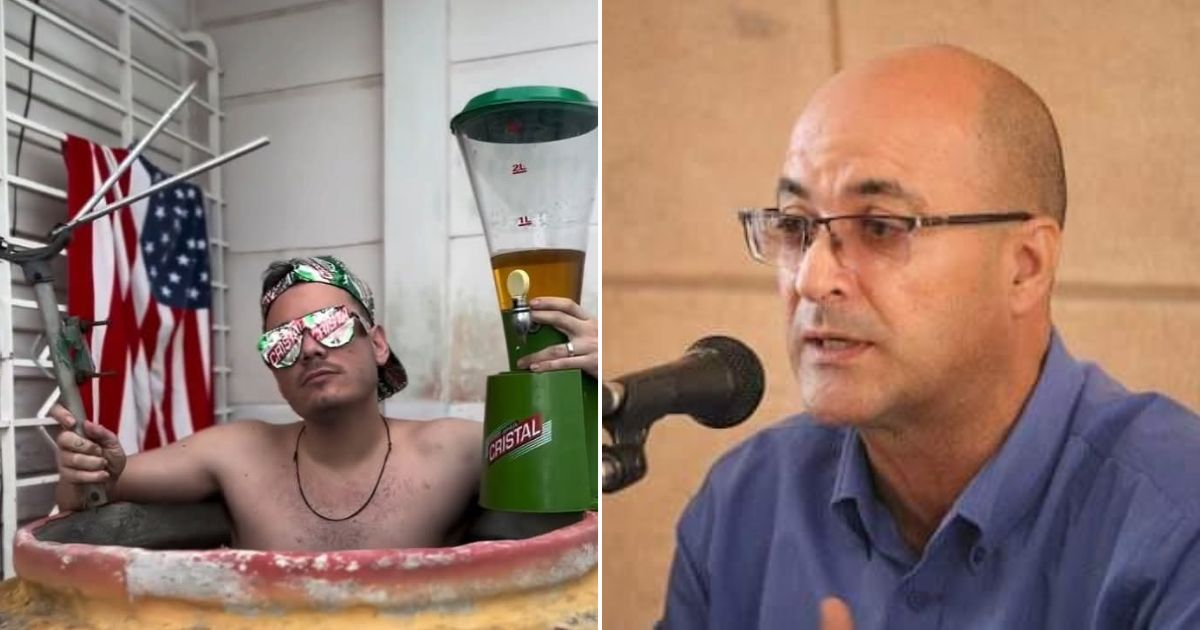
For years, Sandro Castro, the grandson of Cuba's authoritarian leader, Fidel Castro, has become synonymous with extravagance, public disdain, and mockery of the Cuban people by flaunting luxury cars, hosting exclusive parties, and displaying arrogant behavior on social media. Despite the symbolic damage this causes to the Cuban regime, few within the official ranks have condemned his actions.
However, on Thursday, this pattern shifted. Ernesto Limia, an official regime spokesperson known for his work as a lawyer, writer, essayist, and historian, took to Facebook to publish a lengthy and impassioned critique of Sandro, labeling him directly as an "imbecile." This outburst was publicly supported by Gerardo Hernández Nordelo, a prominent figure among the so-called "Five Heroes" and the current national coordinator of the Committees for the Defense of the Revolution (CDR), who endorsed the text with a brief yet telling "Amen," signaling his agreement with Limia's assessment and disdain for Sandro Castro's behavior.
In his piece titled "Te lo prometió Martí...," Limia attempts to absolve Fidel Castro of his grandson's actions and privileges, a clear manipulation by the regime spokesperson. "I don't know where Sandro got his money from, but I'm sure Fidel didn't give it to him. This people knows it, and so does the CIA," he asserts, in a statement that borders on the absurd and deliberately ignores the privileged environment Sandro grew up in, surrounded by resources, access, protection, and institutional silence, which he ultimately inherited.
The text oscillates between defending Fidel's legacy, idealizing Martian values, and critiquing social media as platforms that "exacerbate anger and resentment," a crude attempt to divert attention from the real issue: the privileges Sandro Castro enjoys due to his last name, highlighting the existence of a law-exempt class in Cuba.
Yet, instead of acknowledging the complicity of the system that nurtured and shielded him, Limia points fingers at external foes: "Our enemies know this and thus incite his foolishness," he writes, as if Sandro's irresponsibility were a concoction crafted in Miami.
What Limia fails to state—and likely cannot state—is that Fidel's grandson's behavior is not an anomaly but rather the logical outcome of a ruling class that has lived for decades insulated from the hardships of the average Cuban, surrounded by privileges they deny in rhetoric but exercise in practice. Sandro merely made it visible.
Despite his forceful tone, the essayist warns that imprisoning Sandro without legal grounds would be a mistake, fearing the global media impact: "The Cuban Revolution devours its children like Saturn..."; however, the lawyer seems to forget—conveniently—that there are young Cubans imprisoned for less disrespectful statements than those made by the dictator's grandson.
Incidentally, Limia's post included an image of Sandro Castro drinking Cristal beer in front of a United States flag, a symbol that for decades led to harassment, stigmatization, and punishment for many young Cubans, simply for showing the slightest sympathy towards American iconography.
The contradiction is obvious: what was once a reason for repression is now tolerated—or silenced—if the perpetrator belongs to the ruling circles. The issue isn't about justice but narrative control, with the concern being not the act itself but the scandal it causes.
Limia's ultimate aim seems to be safeguarding the symbol rather than challenging the structure that allowed it to exist. He passionately defends Fidel's austere image, his personal sobriety, and even the legend of him walking with worn-out shoes, as if that negated the existence of a shielded, hereditary caste.
It seems Sandro is an annoyance not for his actions but for making them public. Limia's gesture, although unusual within the regime, comes too late and without self-criticism, at a time when the population is enduring one of the worst economic crises, with blackouts, shortages, and mass migration. His writing doesn't condemn the system: it tries to preserve the narrative that all good comes from Fidel, and the bad is a deviation, or worse, the fault of an external enemy.
Cuban Regime's Response to Sandro Castro's Behavior
Why is Sandro Castro criticized by the Cuban regime's spokesperson?
Sandro Castro is criticized for his extravagant lifestyle and behavior, which is seen as a public mockery of the Cuban people and a symbolic damage to the regime.
What does Ernesto Limia's critique reveal about the Cuban regime's stance?
Ernesto Limia's critique reveals a rare internal acknowledgment of privilege within the ruling class, while attempting to absolve Fidel Castro from his grandson's actions and deflecting blame to external enemies.